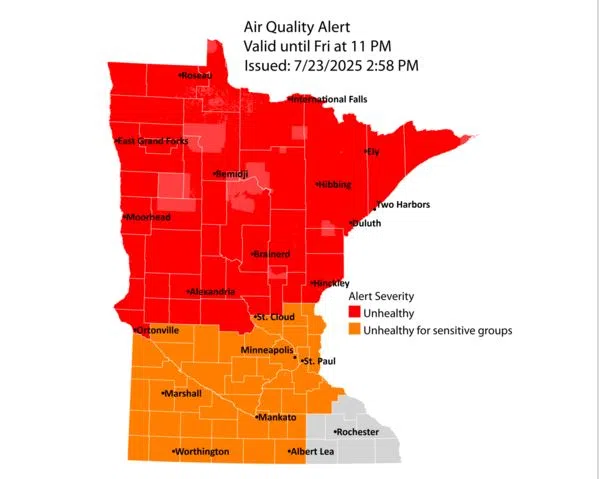
Air quality is expected to reach the red AQI category in northern and central Minnesota, which is unhealthy for everyone
The Minnesota Pollution Control Agency (MPCA) has expanded the current air quality alert to include northern, central, south central, and southwest Minnesota. The alert runs until 11 p.m. on Friday, July 25. The affected area includes the Twin Cities metro area, Brainerd, Alexandria, Albert Lea, Marshall, Worthington, Hinckley, St. Cloud, Ortonville, Mankato, Bemidji, East Grand Forks, Moorhead, International Falls, Two Harbors, Hibbing, Ely, Duluth, Roseau, and the Tribal Nations of Upper Sioux, Mille Lacs, Prairie Island, Leech Lake, White Earth, Red Lake, Grand Portage, and Fond du Lac.
A band of heavy smoke from wildfires in Saskatchewan and Manitoba is moving south across northwest Minnesota on Wednesday. The smoke will remain over the northwest part of the state through the end of Wednesday, but by Thursday morning the smoke will reach southwest Minnesota. Smoke will also move into the northeast and central portions of the state Thursday morning, and by Thursday afternoon smoke will reach east central and south central Minnesota. Some uncertainty remains regarding how far south the ground-level smoke will reach by Friday morning, when winds are expected to become southerly and push the smoke back to the north. Air quality should improve gradually from south to north beginning Friday afternoon, with improvement in fine particle levels below the alert threshold expected by the end of Friday.
Fine particle levels are expected to reach the red air quality index (AQI) category, a level considered unhealthy for everyone, across northern and central Minnesota. This area includes Brainerd, Alexandria, Hinckley, Ortonville, Bemidji, East Grand Forks, Moorhead, International Falls, Two Harbors, Hibbing, Ely, Duluth, Roseau, and the Tribal Nations of Mille Lacs, Leech Lake, White Earth, Red Lake, Grand Portage, and Fond du Lac. In the red area, sensitive groups should avoid prolonged or heavy exertion and limit time spent outdoors. Everyone should limit prolonged or heavy exertion and time spent outdoors.
Fine particle levels are expected to reach the orange AQI category, a level considered unhealthy for sensitive groups, across central, south central, and southwest Minnesota. This area includes the Twin Cities metro area, Albert Lea, Marshall, Worthington, St. Cloud, Mankato, and the Tribal Nations of Upper Sioux and Prairie Island. In the orange area, sensitive groups should limit prolonged or heavy exertion and time spent outdoors.