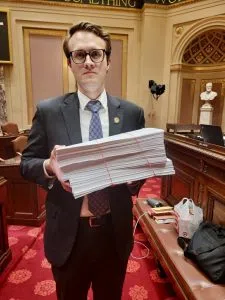
Senator Rasmusson holding a copy of the omnibus bill that was introduced on the last day of the legislative session. (Senator Rasmusson’s Office)
St. Paul, MN – On Monday, August 18, the Second Judicial District Court of Minnesota severed and struck down part of the 2024 omnibus tax bill for violating the single-subject clause of the Minnesota Constitution.
Senator Jordan Rasmusson (R-Fergus Falls) says, “In the final minutes of the 2024 legislative session, Democrats pushed through a 1,400-page omnibus bill. At the time, I called it a ‘shocking display of one-party control.’ The bill was pushed through without debate or time to review its contents. This is not the transparent, accountable legislating Minnesotans deserve.”
Part of the tax bill that was struck down was a ban on binary triggers for firearms.
State Representative Jeff Backer (R–Browns Valley) also released a statement following the ruling, saying, “The ruling yesterday validates what many of us cautioned about from the beginning: a bad policy was hidden in a massive bill, rushed through with little regard for proper process. In the final hours of session, more than 1,400 pages touching nearly every area of government were crammed into one catch-all bill and forced through overnight. That’s not good government — it’s steamrolling, and our Constitution was written to prevent it. Minnesotans expect and deserve lawmakers who uphold the Constitution, follow the rules, and act in the open. Today’s court decision is a win for those principles and for every Minnesotan who wants honest, accountable government.”
“The recent district court ruling shows why Minnesota has a single-subject requirement in our constitution. We need to put Minnesotans first in all our legislative decisions, not block their elected representatives from debating key policy issues. Legislators should heed the court’s warning on unconstitutional bills,” Rasmusson concluded.
On May 22, 2024, Republican minority leaders authored a letter to Governor Walz urging him to veto the omnibus tax bill, emphasizing that “signing this bill will be an endorsement of a process that will have serious consequences for both chambers for years to come.”





FOLLOW US FOR INSTANT UPDATES!


