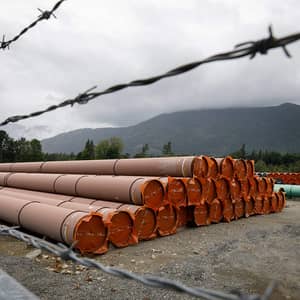
Most Canadians want a pipeline. Nobody wants to pay for it
Pipelines, pipelines, pipelines. No matter how you feel about them, it’s hard to escape news of them lately.
In July, the Alberta government announced it is formally proposing another pipeline to the West Coast. On the weekend, the federal government took another step towards designating the pipeline as a project in the national interest, meaning environmental assessments and other parts of the approval process could be fast-tracked.
Recent polling shows the majority of Canadians — 63% according to the Angus Reid Institute in July — support that new pipeline from Alberta to British Columbia.
Why? Mostly for economic reasons. A majority told pollsters they were convinced by the argument that Canada needs to diversify its oil markets away from the U.S., while half said oil is just generally important to the economy. Forty-five percent said the project would create jobs.
The economic forecast, though, isn’t quite that simple. There’s still the question of who’s going to pay for it. A poll commissioned by the Pembina Institute and conducted by Probe Research in April found a majority of Albertans — 61% — say they don’t want to spend taxpayer money on a new pipeline.
It’s increasingly clear: Many Canadians say they do want a new pipeline, but they don’t want to pay for it. Companies aren’t exactly lining up to build new pipelines by themselves, either. That raises a question: Why?
So what are the economics of a pipeline in Canada? Do they make money? The Narwhal broke down what you need to know.
Key Takeaways
- As polls suggest a majority of Canadians support building new pipelines, the Alberta government is proposing a new pipeline to the West Coast to help boost production in the oil sands.
- The terms of the pipeline proposal name Alberta and the Canadian government together as majority owners, suggesting taxpayers will foot much of the construction bill.
- Pipelines are very expensive to build. A recent analysis of the federal government’s Trans Mountain pipeline, which is already operational, showed that the pipeline’s revenues aren’t high enough to cover its construction and debt costs, making it a money-loser for taxpayers.
How much do pipelines cost to build?
No one is going to build a pipeline on a shoestring. These are multibillion-dollar projects, often crossing multiple provinces. Even expanding an existing pipeline, or building along an existing pipeline route, is a huge endeavor involving tens of thousands of people working on the project.
Take the Trans Mountain Expansion project, as an example. That increased the capacity of an existing pipeline, built in the 1950s, from Alberta to the West Coast. That expansion project ultimately cost taxpayers 34 billion Canadian dollars — notably, that’s almost CA$30 billion more than initial estimates.
The latest pipeline idea making headlines was proposed by the Alberta government, with an estimated cost pegged at between CA$35.2 billion and CA$43.7 billion. That proposal was brought forward alongside the federally owned Trans Mountain Corp., which will lead the project, and Pembina Pipeline Corp. (which is not connected to the Pembina Institute that held the poll).
Under the proposed partnership, Trans Mountain and the Government of Alberta — through the Alberta Petroleum Marketing Commission — would hold a majority interest.
So who would actually own it? Well … taxpayers, in a way.
How much have taxpayers spent building pipelines in the past?
How much taxpayers have already spent on pipelines varies. Canadian taxpayers have been on the hook for billions since the Government of Canada purchased the Trans Mountain pipeline in 2018.
And maybe that’s okay. Some would argue that pipelines are infrastructure, much like highways or railways. Others disagree that billions of dollars of public money should be put toward increasing oil and gas infrastructure.
Nonetheless, it continues to happen. TC Energy’s canceled Keystone XL expansion was backstopped by Alberta taxpayers to the tune of CA$1.5 billion in 2021.
And it’s happening again. Alberta’s government has already contributed a little more than CA$18 million to its latest pipeline plan, saying the money went to early planning work “including preliminary engineering, cost estimates, economic modeling, early Indigenous engagement with communities and development of the proposal for federal consideration.”
The Alberta government calls it a “myth” that it will pay for the entirety of the pipeline, saying, “Now that this preliminary work is done, we will work alongside Trans Mountain and Pembina Pipeline to move this project ahead.” But Pembina Pipeline currently has only a 10% stake in the project.
So, in the end, it appears if the West Coast pipeline project moves ahead, it will be governments — and taxpayers — who foot much of the bill.
“I am quite comfortable that this is a good investment for Canadian taxpayers,” federal Energy and Natural Resources Minister Tim Hodgson told CBC in July.
How does a pipeline operator make money?
Whether pipelines are owned by companies or governments (and taxpayers like you), they charge fees for companies to move their products. The fees paid to use pipelines by companies such as oil producers are called tolls or tariffs.
The Canada Energy Regulator oversees pipeline tolls, saying it ensures “they are just and reasonable.”
According to the regulator, tolls “cover the company’s cost of service, including a fair and reasonable return to pipeline investors.” Rates vary based on many factors: whether there’s a long-term commitment to shipping, how far, what the product is and how much of it.
The Trans Mountain expansion ended up costing so much that the tolls it charges customers to move oil are higher than expected. Still, according to the International Institute for Sustainable Development, only CA$15.4 billion of the CA$34 billion cost of the pipeline is covered by the tolls it charges.
Does running a pipeline actually make money?
Take a look at the Trans Mountain Corp. as an example — that pipeline Canadians all own together.
The company says it is now profitable. It reported its net income for 2025 was CA$556 million — up from CA$5 million the year before.
It’s what Minister Hodgson described to CBC as “generating oodles of cash.”
But that claim has raised some eyebrows. And untangling it is complicated.
The Trans Mountain Corp. is a wholly owned entity of another company, Canada TMP Finance Ltd., which is itself a subsidiary of Canada Development Investment Corp., the entity which holds the Government of Canada’s investment in Trans Mountain. Still following?
Look in the opposite direction. The Government of Canada owns a Crown corporation. That corporation has a subsidiary, which then in turn owns Trans Mountain Corp. Hopefully that helps.
The debt of the expansion, and the interest on that debt, isn’t paid off. But Hodgson can claim the pipeline is profitable because of the confusing corporate structure of which Crown corporation holds its construction debt and pays the interest, and which takes in the tariffs, according to a report from the International Institute for Sustainable Development.
The author of the report described Trans Mountain’s profit claims to The Tyee as a “misrepresentation of finances.”
Trans Mountain Corp. did not respond to questions from The Narwhal by publication time.
But a company’s balance books aren’t the only way of looking at it. Industry advocates argue pipelines generate money in other ways too, including tax and royalty revenues and making oil prices more competitive.
For example, a 2024 report from a group created for Alberta credit unions argued the Trans Mountain expansion project resulted in a significant increase in access to markets for Alberta oil and that access significantly narrowed the price difference between a type of Western Canadian oil called Western Canada Select and a type sold out of Texas called West Texas Intermediate. The report estimated this had already increased revenues by about CA$10 billion in the first six months the pipeline expansion launched.
There’s little doubt that producing and exporting oil and gas makes money for Canada — and especially for oil and gas companies themselves. But many have argued a fuller accounting would include the significant costs of the health risks, environmental degradation and other damage that comes from increasing carbon pollution from the burning of fossil fuels.
What are the costs of carbon pollution from increasing oil production?
Fossil fuel production is driving climate change, and the consequences are being felt today. Life is more expensive, cities have dirtier air from wildfires, deadly heat waves and other extreme weather events are more common, First Nations are disproportionately threatened with disasters and Canadians are more at risk of poverty, heart disease, cancer and premature death.
As The Narwhal has reported, it’s possible, at least broadly speaking, to compare the economic output of fossil fuels with health costs. The federal energy regulator, for example, has reported the total value of crude oil exports from Canada was CA$138 billion in 2024. A Health Canada report that same year found the total cost of health impacts attributable to air pollution in 2018 was CA$146 billion. The cost of many foods produced in Canada is also rising as farming becomes less predictable.
Estimates vary, but the short answer is climate change is expensive. A 2022 report from Queen’s University projected trillions of dollars in losses in Canada due to climate change this century, with the greatest contributor to that change being the burning of fossil fuels.
Does Alberta produce enough oil to fill a new pipeline?
Trans Mountain is currently “Canada’s only pipeline system transporting oil products to the West Coast.” The company says its 1,200-kilometre pipeline network has room for 890,000 barrels of petroleum products to be shipped each and every day.
The new pipeline proposed by the Alberta government would be capable of transporting 1 million barrels of crude oil per day from the Edmonton area to the West Coast.
If it goes ahead, that would significantly increase the network of pipelines leading from Alberta.
There are already several other pipeline systems in use — leading to other locations in the U.S. and eastern Canada — and according to the Alberta Energy Regulator, all of them together could carry 5.4 million barrels per day.
Currently, Alberta produces an average of more than 4 million barrels of oil per day. That suggests Alberta’s oil production stands to increase substantially if a new pipeline is going to be filled each and every day.
Meanwhile, the International Energy Agency has predicted global demand for oil from combustible fossil fuels may peak as early as 2027 — raising questions about the long-term outlook for expanded oil sands production.
With files from Drew Anderson and Carl Meyer.
This story was produced by The Narwhal and reviewed and distributed by Stacker.